Phonetics is basically the study of the sounds of human speech. In other words, we are learning all of the sounds that the human mouth can make to form words and the symbols that go along with each sound.
And believe it or not, English does not use all of the sounds the human mouth can make. I've been making sounds in classes the past few weeks that I have never made before...it's oftentimes very humorous!! Thankfully, they divide us into small groups for this class...so we only have to make fools of ourselves in front of about eight people instead of 45 people. :)


So think about English for a second. How would you say this (made-up) word?
"nough"
Would you say it like dough? (no)
Or maybe like bough? (now)
Or maybe like through? (new)
Or maybe like rough? (nuff)
The thing is...all of those could be right. Because English (and many other languages as well) is very inconsistent in its spelling. We spell dough, bough, through, and rough all with the same four-letter combination--"ough." But we pronounce them all differently!
So now picture this: It's two or three years in the future, and Aaron and I, along with Nathan and Rachel and another couple are on Day #1 of learning a new tribal language. We have moved in to the tribe, gotten settled, and we now spend the day out in the village trying to catch just a few words of their language on our first day. I point to a tree to see if a tribal lady will tell me the word for it. She says a word, so I write it down as best I can, so that I can remember it later and share it with my husband and coworkers as well.
Six hours later, I sit down with Aaron to show him some of the words I picked up. I have this written:
Tree= "abahihigo"
I try to pronounce it, but I can't remember what I was thinking when I wrote it down! Are the "a's" supposed to be "short a's" (like in apple), "long a's" (like in cape), or more of a "short u" sound (like in pita)? Or is one long and one short? Are the "i's" supposed to be "short i's" (like in bit) or "long i's" (like in bite) or even "long e" sounds (like in liter)?
Because English spelling is so inconsistent, there is no way we would be able to remember how to pronounce a word by using the English alphabet to write it!
So that's where the Phonetic Alphabet comes in!
The phonetic alphabet assigns only one single symbol to every individual sound that the human mouth can produce. So when we are learning a tribal language and writing down (in phonetics!) what the tribal people are saying, there won't be any guessing later as to what we meant when we wrote it.
Each day in class, we learn more and more about the various sounds that the human mouth can produce.
We learn things like WHERE in the mouth each sound is produced. (This is called the point of articulation.)

For example, say the word "five." For both the "f" sound and the "v" sounds, your lower lip touches your upper teeth. (And another interesting thing about those two sounds is that they are essentially the exact same sound...you are just "turning your voicebox on" for the "v" sound and not for the "f" sound).
However, there is a sound used in other languages that sounds very, very similar to an "f" sound, but instead of being made with your lower lip touching your upper teeth, it is made with both of your lips touching each other. Go ahead and try it...you will basically just feel like you are blowing out a candle or something. But that is an actual sound used in other languages! Before taking Phonetics, we would have heard someone in the tribe say a word with that sound in it and we would have just written down an "f" for it...but since it is not actually an f sound...since it is slightly different...our pronounciation of it would have always been just slightly off. And that is the difference between sounding native to the language (which is one of our goals) and having a noticeable distracting accent.
We also learn things like HOW the sound is produced in the mouth. Some sounds are produced by cutting the airflow off from the lungs and then letting it out in a short burst (English consonants like b, d, p, t, k, and g are made like this).
Other sounds are made just by restricting the airflow--but never cutting it off completely (English consonants like f, v, z and s are made like this).
Other sounds are made by redirecting the air through your nose instead of your mouth (English consonants like m and n are made like this). By the way, have you ever wondered why it sounds like you are saying "Bob" when you try to say the word "Mom" when you have a cold and a stuffed-up nose? It's because the English B sound and M sound are essentially the same sound...but for the M, the air is directed through the nose, and for the B, the air is directed out the mouth. When your nose is closed up, the air can only come out of your mouth, so it sounds like a B!
And finally, we are learning the phonetic symbols for each sound.
Consonants:

Vowels:
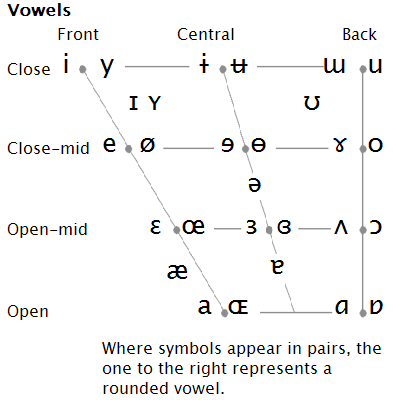
These symbols will be so invaluable to us to know when we are learning the tribal language, like I said before.
Here are some examples of phonetic writing:
Here are some examples of phonetic writing:
Aaron = ˈʔeəɹən
Jill = dʒɪl
Ivy = ˈʔaivi
Israel = ˈʔɪzɹiˌl
Abel = ˈʔeibˌl
We love phonetics =
wi lʌv fəˈnɛɾɪks
wi lʌv fəˈnɛɾɪks
We can't wait to use this in the tribe =
wi kænt weit tʰu juz ðɪs ʔɪn ðʌ tʰraib
wi kænt weit tʰu juz ðɪs ʔɪn ðʌ tʰraib
Thanks for reading this really long post! =
θeŋks fɔɹ 'ridiŋ ðɪs 'rili lɔŋ pʰoust!
θeŋks fɔɹ 'ridiŋ ðɪs 'rili lɔŋ pʰoust!

7 comments:
great post and very interesting. but sounds like A LOT of hard work to learn!!
love you
gma jan
oh my word -- this is SO interesting!! thanks for sharing!
Wow sis. That took a long time to write that post! I am so thankful you did it, though--thanks for doing all the hard work :) You did an awesome job explaining it! And I'm with you, Alisha--I am so lazy with my speech (like most Americans) that I also use schwa's way too much probably. Jill, how did you type phonetic symbols in your blogpost??? Love this post!
Alisha--Aaron and I both kept going back and forth and back and forth about Aaron. We considered an epsilon...I finally found some different phonetic "translators" online, and typed in words like Aaron, air, etc. Almost all of them had a "e" glided into a schwa. So we just went with it :)
And I think Israel's name may be better with the schwa now that you say that, but I think I would stick with the syllabic l for Abel's name ;)
Rachel--I found a site online where there is a phonetic "keyboard" that you can use to type something and then copy and paste it into a different document!
Reading your blog, it kind of makes my head spin, but then I never was very good in English class.(you can also tell that if you read my comments). It is very interesting though.
Grandpa Jim
Wow, Jill! Very interesting!
Yep~ I was excited to read what you are learning! I used to take notes phonetically sometimes in class... it because a short hand for me because it was SO drilled into my head!
Post a Comment